The Transition to Empire
The Roman political system evolved from a Republic to an Autocracy. Although the Senate continued to exist, the Emperor held supreme authority as the Princeps, controlling the army and the treasury.
Discover the civilization that changed the course of history, from its foundation in 753 BC to the fall of Rome in 476 AD.
Rome originated as a small village on the banks of the Tiber River and grew into one of the most powerful empires in the ancient world. Its influence spanned three continents, leaving its mark on the politics, architecture, law, and Western culture.

The earliest phase of Rome ruled by kings, traditionally starting with Romulus.

A period of elected magistrates and senatorial governance, marked by internal reforms and territorial expansion.
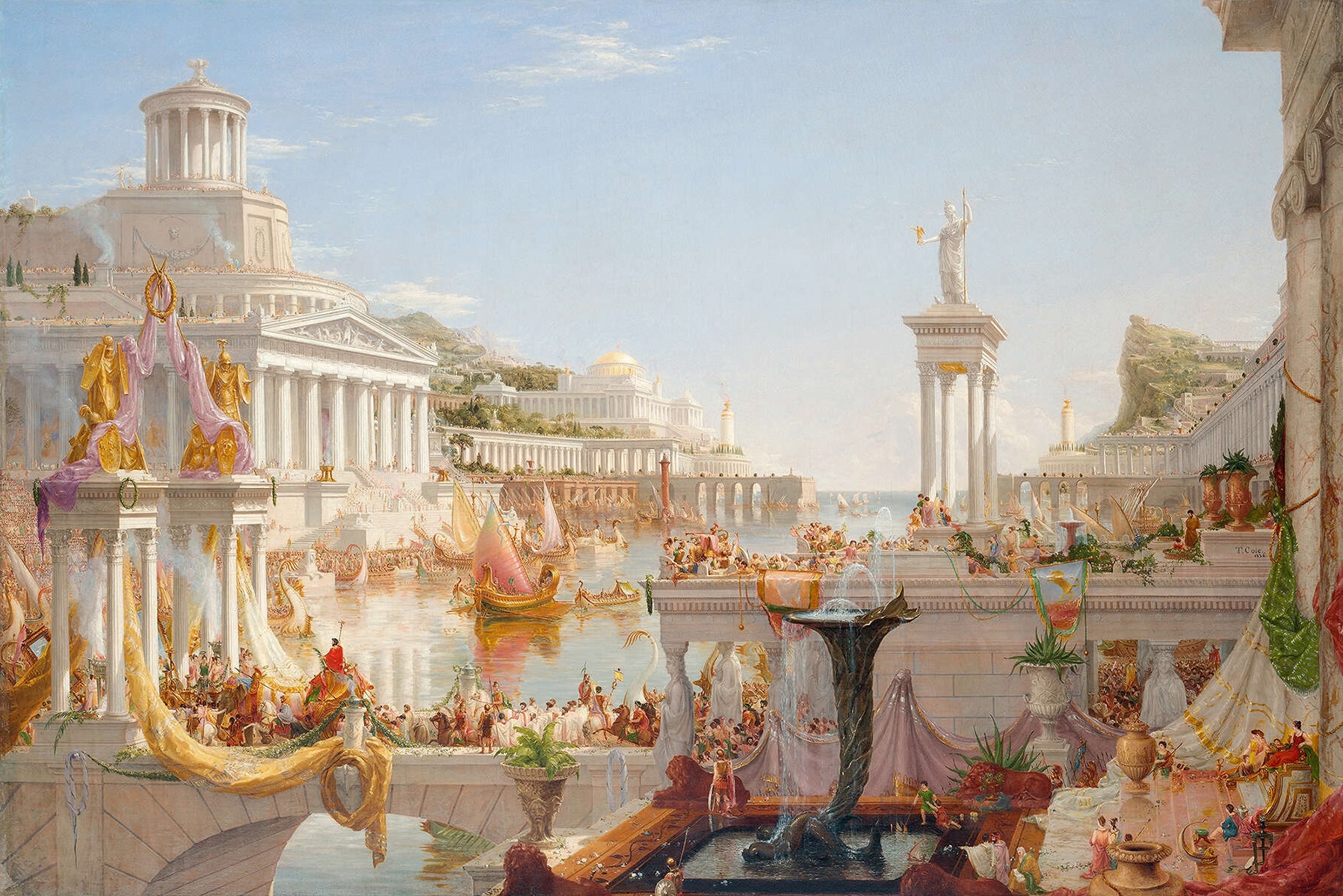
Augustus became the first emperor, ushering in centuries of imperial dominance and cultural achievement.

The Eastern continuation of the Roman Empire centered in Constantinople, lasting nearly a thousand years after the fall of the West.
The Roman political system evolved from a Republic to an Autocracy. Although the Senate continued to exist, the Emperor held supreme authority as the Princeps, controlling the army and the treasury.
To manage vast territories, Rome divided its lands into Provinces. Governors were appointed to collect taxes and maintain order, ensuring thatRoman Law was applied from Britain to Egypt.
The backbone of Rome was the Legionary. These professional soldiers served for 20 years and were famous for their discipline, engineering skills, and the iconic Scutum (shield) and Pilum (javelin).
Roman victory often came from fortification. Legions could build fortified camps in hours and permanent roads that allowed rapid deployment across the empire.
A single currency, the Denarius, and the safety of the Mediterranean Sea (Mare Nostrum) facilitated a massive trade network. Silk from China and spices from India flowed into the capital.
The economy was largely agrarian, based on Latifundia (large estates). Unfortunately, this system relied heavily on slave labor, which provided the workforce for mines and farms.
Roman society was strictly divided between Patricians (aristocracy),Plebeians (commoners), and Freedmen. Social mobility was possible but difficult, often achieved through military service.
To prevent urban unrest, emperors provided Panem et Circenses. Free grain and public spectacles in the Colosseum or the Circus Maximus kept the massive population of Rome entertained and fed.
The discovery of Pozzolanic concrete allowed Romans to build structures of unprecedented scale. The arch and the dome, as seen in the Pantheon, changed architecture forever.
Roman cities enjoyed running water thanks to massive Aqueducts. This supported a culture of public health through Thermae (public baths) and sophisticated sewage systems like the Cloaca Maxima.
The Roman political system evolved from a Republic to an Autocracy. Although the Senate continued to exist, the Emperor held supreme authority as the Princeps, controlling the army and the treasury.
To manage vast territories, Rome divided its lands into Provinces. Governors were appointed to collect taxes and maintain order, ensuring thatRoman Law was applied from Britain to Egypt.
The backbone of Rome was the Legionary. These professional soldiers served for 20 years and were famous for their discipline, engineering skills, and the iconic Scutum (shield) and Pilum (javelin).
Roman victory often came from fortification. Legions could build fortified camps in hours and permanent roads that allowed rapid deployment across the empire.
A single currency, the Denarius, and the safety of the Mediterranean Sea (Mare Nostrum) facilitated a massive trade network. Silk from China and spices from India flowed into the capital.
The economy was largely agrarian, based on Latifundia (large estates). Unfortunately, this system relied heavily on slave labor, which provided the workforce for mines and farms.
Roman society was strictly divided between Patricians (aristocracy),Plebeians (commoners), and Freedmen. Social mobility was possible but difficult, often achieved through military service.
To prevent urban unrest, emperors provided Panem et Circenses. Free grain and public spectacles in the Colosseum or the Circus Maximus kept the massive population of Rome entertained and fed.
The discovery of Pozzolanic concrete allowed Romans to build structures of unprecedented scale. The arch and the dome, as seen in the Pantheon, changed architecture forever.
Roman cities enjoyed running water thanks to massive Aqueducts. This supported a culture of public health through Thermae (public baths) and sophisticated sewage systems like the Cloaca Maxima.
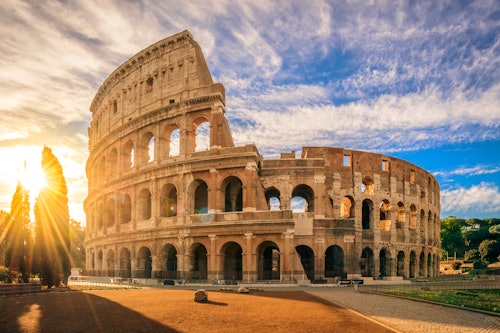
The Colosseum of Rome
The Colosseum, a symbol of Roman greatness, hosted spectacles and gladiator contests before tens of thousands of spectators.
The decisive conflict between Julius Caesar and Pompey the Great that marked the end of the Roman Republic and Caesar's rise to absolute power.
The three defining conflicts between the Roman Republic and Carthage, which determined the supreme power of the Mediterranean world.
The two military campaigns led by Emperor Trajan against King Decebalus of Dacia, resulting in Rome's greatest territorial acquisition and immense wealth.
A series of conflicts lasting centuries, beginning with the explosive Rashidun conquests and evolving into a protracted border struggle that reshaped the Middle East and North Africa.
The most infamous of the Crusades, diverted from its goal of recapturing Jerusalem to the conquest and brutal sack of the Christian city of Constantinople, leading to the temporary collapse of the Byzantine Empire.